If you run a travel agency that sells through other agents, a B2B travel portal is the single system that decides how fast you grow. It is where your sub-agents search fares, book tickets, pay from their wallet and download their own invoices, without calling your office every time.
This guide explains what a B2B travel portal is, how it works behind the scenes, which features actually matter, and how to choose the right one for your agency.
What is a B2B travel portal?
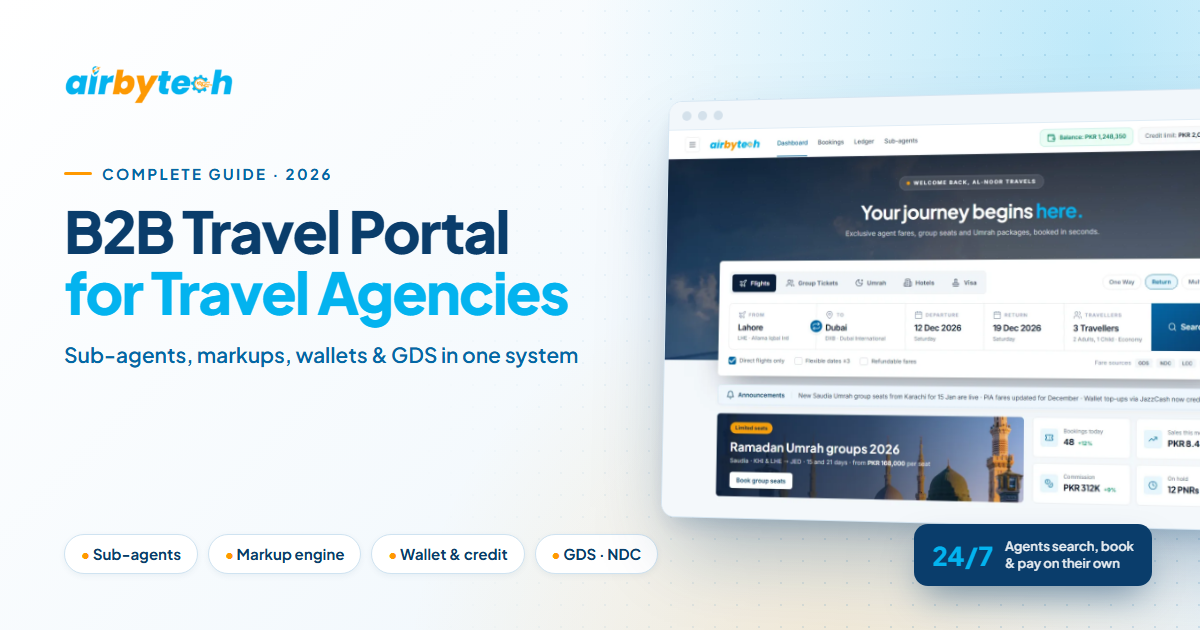
A B2B travel portal is a private booking website for travel agents, not travellers. You (the consolidator or host agency) connect your airline, hotel and package inventory to the portal, set your prices, and give each sub-agent a login. They then book on their own, 24/7, using credit you control.
Think of it as your agency's counter, open online to hundreds of agents at once.
| B2B travel portal | B2C booking website | |
|---|---|---|
| Who books | Registered travel agents and sub-agents | The public (end travellers) |
| Pricing | Net fares plus your markup, different per agent | One public selling price |
| Payment | Agent wallet, credit limit, bank deposit | Card or online payment at checkout |
| Login | Required: every agent has an account | Optional |
| Goal | Grow distribution through a network | Sell directly to customers |
If you want both, the same inventory can power a B2B portal and a B2C booking platform side by side.
How a B2B travel portal works
Behind a simple search box, a lot happens in a few seconds:
- The agent searches. For example, Lahore to Jeddah, 2 adults, economy.
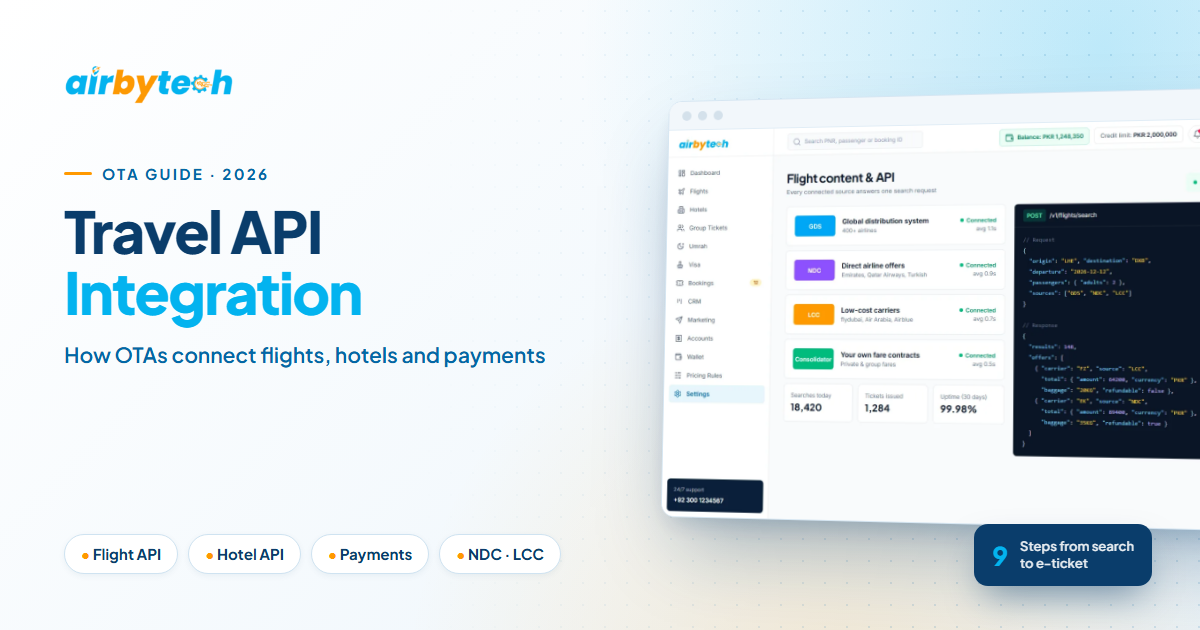
- The portal asks every connected supplier at once: GDS content (Amadeus, Sabre, Travelport), NDC airline connections, low-cost carriers and hotel APIs. If GDS is new to you, read our guide on what a GDS is and how agencies use it.
- Results are merged and cleaned. Duplicate fares are removed and sorted by price, airline and duration.
- Your pricing rules are applied. The agent sees net fare plus the markup you set for their group, never your cost.
- The agent books. The portal creates the PNR, checks the agent's wallet balance or credit limit, and holds or issues the ticket.
- Documents go out automatically. E-ticket, invoice and voucher, in the agent's own branding if you allow it.
- Your back office is updated. Sales, payables and the agent's ledger change in real time.
That middle layer, connecting many suppliers to one search, is what travel API integration is all about.
Must-have features of a B2B travel portal
Not every portal is built for a real agency network. These are the features that save you time and money every day.
1. Sub-agent management
- Unlimited agent and sub-agent accounts, each with their own staff logins.
- Agent groups (for example Gold, Silver, New) so pricing and credit can be set per group.
- Approval flow for new agent registrations, with document upload (CNIC, trade licence, IATA number).
2. Markup and commission control
- Markup by airline, route, cabin class, supplier or agent group: fixed amount or percentage.
- Separate markup on hotels, packages and visas.
- Agents can add their own markup on top for their customers.
Tip: Agencies that set markup per route instead of one flat rate usually win more bookings on competitive routes while keeping margin on the rest.
3. Wallet, credit limit and payments
- Pre-paid agent wallet with deposit requests and proof upload.
- Credit limit per agent, with automatic booking block when the limit is crossed.
- Online top-up through payment gateways, plus manual bank deposit approval.
- A full ledger the agent can download, so you stop answering "what is my balance?" calls.
Here is how a payment and wallet module handles this inside a travel system.
4. Real-time inventory from multiple sources
- GDS fares for full-service airlines.
- NDC content, which gives access to airline-direct fares and bundles. IATA explains the standard on its NDC program page.
- Low-cost carriers and your own private or group fares (blocked seats for Umrah or Hajj season, for example).
- Hotels, transfers, tours and visa services in the same search.
5. Booking management and after-sales
- Hold, issue, void, refund and reissue from the portal.
- Queue for pending tickets and schedule changes.
- Cancellation and refund requests with status tracking.
6. Branding and white label
- Your logo, colours and domain on the portal.
- Optional white label for big sub-agents, so their customers see their brand on tickets and invoices.
7. Reports and back office
- Sales by agent, airline, route and period.
- Receivables, payables and supplier reconciliation (BSP or airline statements).
- Exportable reports for your accountant.
8. Security and control
- Role-based access for your staff.
- Two-step login, IP rules and activity logs.
- Fare and booking audit trail: who booked, changed or cancelled what, and when.
Build vs buy: which one is right for you?
| Build from scratch | White-label B2B portal | |
|---|---|---|
| Time to launch | 8 to 18 months | A few weeks |
| Upfront cost | High: full development team | Lower: setup plus subscription or licence |
| Supplier connections | You negotiate and certify every API | Already integrated and tested |
| Maintenance | Your responsibility forever | Handled by the provider |
| Best for | Large consolidators with an in-house tech team | Most agencies that want to grow fast |
For most agencies, a white-label portal that can still be customised is the faster and safer route: you keep your brand and pricing control while the provider handles airline changes, API updates and uptime.
How to choose a B2B travel portal provider
Ask every provider these questions before you sign:
- Which suppliers are already live? Ask for a list, not "we can integrate anything".
- Can I see a working demo with real search results? A live system tells you more than any slide deck. You can try our live demos here.
- How flexible is the markup engine? Can you set rules per agent group and per route?
- How are wallet and credit limits handled? Are bookings blocked automatically?
- Who owns the data? Your agent list and booking history should always be yours.
- What does support look like during peak season (Umrah, Hajj, holidays)?
- Is pricing clear? Setup, monthly cost and per-booking fees should be written down. Compare with our pricing page.
- Is there a mobile-friendly or app experience for agents on the go?
Common mistakes agencies make
- One flat markup for everything. You lose sales on competitive routes and margin on easy ones.
- Giving credit without automatic limits. One unpaid agent can wipe out a month of profit.
- Choosing a portal with only one supplier. If that supplier has an outage or bad fares, your whole network stops selling.
- Ignoring after-sales. Refunds and reissues handled by phone and WhatsApp eat your team's day.
- No reporting. Without agent-wise sales reports you cannot see who is growing and who needs attention.
The future of B2B travel distribution
- NDC adoption is growing, so portals that only show GDS fares will miss airline-direct offers.
- Bundled offers (seat, bags, meals) are becoming normal in agent searches.
- Automation in after-sales (auto-refund, schedule-change alerts) is turning into a basic expectation.
- Mobile-first agents, especially in Pakistan, the Gulf and South Asia, expect to book and top up their wallet from their phone.
Agencies that move to a modern portal now will be ready for these changes instead of chasing them.
Ready to launch your own B2B travel portal?
Airbytech's B2B Travel Portal gives you sub-agent management, a flexible markup engine, wallet and credit control, GDS and API inventory, and a full back office, under your own brand.
- See it working: open the live B2B demo
- Talk to us: book a free consultation
Frequently asked questions
What is the difference between a B2B and a B2C travel portal?
A B2B portal is for travel agents who book on behalf of customers, using net fares, markups and agent wallets. A B2C portal is a public website where travellers book and pay directly.
How much does a B2B travel portal cost?
It depends on the suppliers you need, the number of agents and how much customisation you want. A white-label portal costs far less than building one from scratch and can launch in weeks.
Can sub-agents use their own branding?
Yes. With a white-label option, sub-agents can show their own logo and details on tickets, invoices and vouchers.
Can I connect GDS and low-cost airlines in one portal?
Yes. A modern B2B portal combines GDS, NDC, low-cost carriers and your private fares in one search, so agents compare everything in one place.
How do agents pay for bookings?
Through a pre-paid wallet, a credit limit you set, or online top-up. The portal checks the balance before every booking.
- #B2B Travel Portal
- #Sub-Agent
- #Travel Agency Software
- #NDC
- #White Label
Written by
Airbytech Owner
The Airbytech team builds B2B and B2C booking platforms, GDS integrations and agency software for travel businesses worldwide.
See it working
Try the Airbytech portals with demo logins
Explore the live B2B agent portal and B2C booking website, then talk to us about launching one under your own brand.