If you sell air tickets, you use a GDS every day, even if you never type a single command. Every fare your team quotes, every PNR you create and every e-ticket you issue passes through one of a few global systems.
This guide explains what a GDS is, how it works step by step, the difference between the big three providers, how GDS compares with NDC, and how a GDS API turns a manual ticketing desk into an online booking business.
What is a GDS in travel?
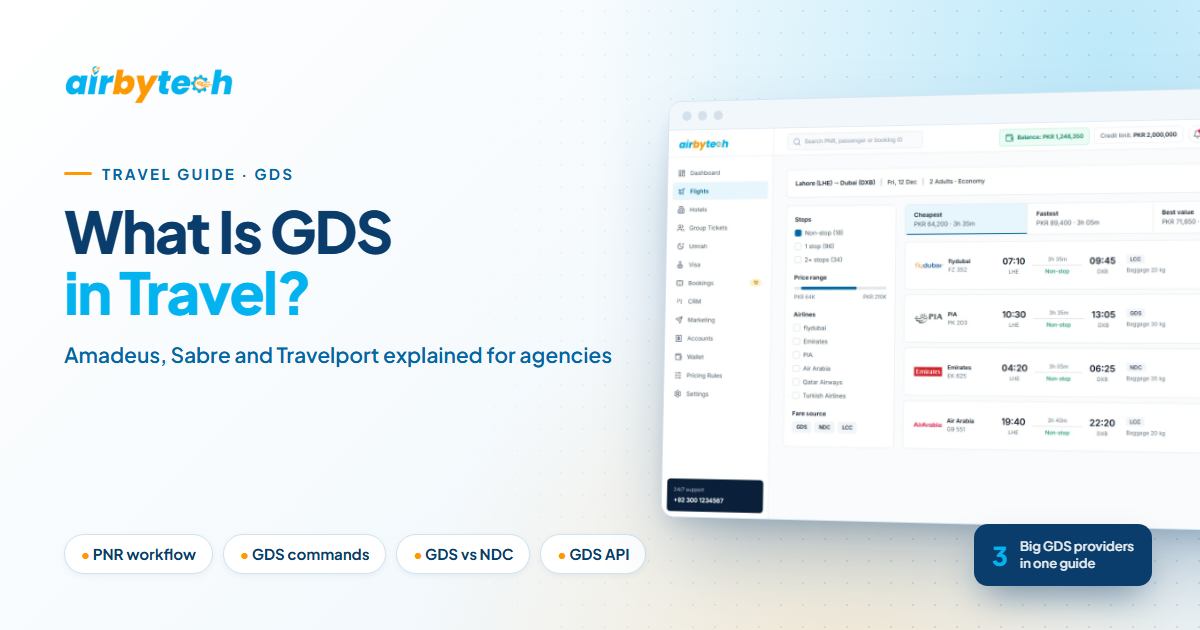
A Global Distribution System (GDS) is a large computer network that connects travel sellers (agencies, OTAs and consolidators) to travel suppliers (airlines, hotels, car rental companies and rail operators).
Through a GDS, an agent can:
- check real-time seat availability and fares on hundreds of airlines,
- create a booking record (PNR) with passenger details,
- price and issue tickets under the airline's fare rules,
- book hotels and cars alongside flights.
Before the GDS, agents had to call each airline. Today one screen shows the whole market.
The three main GDS providers
| Provider | Background | Strong in |
|---|---|---|
| Amadeus | Founded in 1987 by European airlines | Europe, Middle East, South Asia |
| Sabre | Started in 1960 with American Airlines | North America, Middle East, Asia Pacific |
| Travelport | Runs Galileo, Apollo and Worldspan | South Asia, UK, Africa |
In Pakistan and the Gulf, most agencies work on Amadeus, Sabre or Galileo. Which one is "best" depends on your airline mix, your consolidator and the deal you can get on segment incentives.
How a GDS booking works: from search to e-ticket
- Availability. The agent searches a route and date. The GDS shows flights, classes and seats left.
- Sell. The agent picks a class and holds seats for the passengers.
- Build the PNR. Name, contact number, ticketing time limit and "received from" are added. The PNR gets a six-character record locator.
- Price. The GDS calculates the fare, taxes and fare rules (baggage, change and refund penalties).
- Store and end. The fare is stored and the PNR is saved. The airline confirms the seats.
- Ticket. The agent issues the ticket against the agency's IATA or consolidator stock. The ticket number is added to the PNR.
- Report and settle. Sales are reported and settled with airlines, usually through IATA's Billing and Settlement Plan (BSP).
A good online system does all of this in the background. You can see the same workflow, automated, in our flight booking engine.
Basic GDS commands every agent should know
Agents working directly in the GDS use short "cryptic" commands. Here are the most common ones in Amadeus and Sabre:
| Task | Amadeus | Sabre |
|---|---|---|
| Check availability | AN15DECLHEDXB |
115DECLHEDXB |
| Sell a seat | SS1Y1 |
01Y1 |
| Add passenger name | NM1KHAN/ALI MR |
-KHAN/ALI MR |
| Add phone | AP 923001234567 |
9923001234567 |
| Ticketing arrangement | TKOK |
7TAW/ |
| Received from | RFALI |
6ALI |
| Price the PNR | FXP |
WP |
| Save (end) the PNR | ER |
E |
Tip: Commands save time for experienced staff, but they are hard to train and easy to get wrong. A graphical booking portal on top of the GDS lets new staff and sub-agents book without learning cryptic entries.
Advantages of using a GDS
- Huge content in one place: hundreds of airlines plus hotels and cars.
- Real-time accuracy: availability and fares come straight from airline systems.
- Trusted ticketing and settlement through IATA BSP or your consolidator.
- Interline and complex itineraries (multi-city, mixed carriers) are easy to build.
- Industry standard: staff with GDS experience are easy to hire.
Limitations of the GDS
- Cost: GDS fees and contracts can be expensive for small agencies.
- Limited content from some airlines: many low-cost carriers are not fully in the GDS, and some airlines keep their best fares and bundles for NDC.
- Old interfaces: cryptic screens need training.
- Basic retailing: seats, bags and bundles are harder to sell than on airline websites.
GDS vs NDC: what is the difference?
NDC (New Distribution Capability) is a standard created by IATA so airlines can send rich, personalised offers to agencies. You can read the official overview on IATA's NDC page.
| GDS (traditional) | NDC | |
|---|---|---|
| Content | Published fares, classes, seats | Airline offers with bundles, seats, bags and special fares |
| Who builds the offer | GDS from airline filings | The airline itself |
| Format | Older EDIFACT messages | Modern XML APIs |
| Ancillaries | Limited | Full: seats, bags, meals, upgrades |
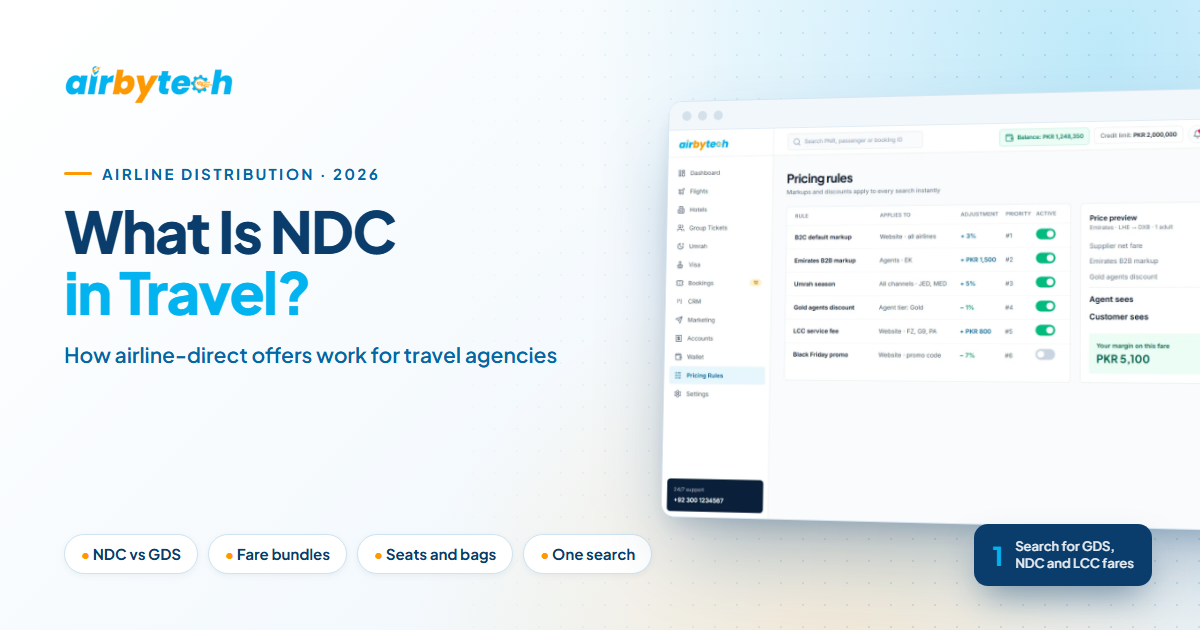
The two are not enemies. Most GDS providers now also deliver NDC content, and modern portals show GDS, NDC, low-cost carriers and private fares in one search.
How a GDS API powers an online travel agency
Your website cannot "type commands". Instead, it talks to the GDS through an API (Application Programming Interface). The API sends a search request, gets fares back as data, and creates bookings and tickets automatically.
With a GDS API connected, you can:
- run a B2C booking website where travellers book and pay online,
- run a B2B travel portal where sub-agents book from their own wallet,
- apply your markups automatically by airline, route or agent,
- combine GDS fares with other suppliers in one search.
For a deeper look at how APIs connect airlines, hotels and payments, read our travel API integration guide, or see our flight API integration service.
How to choose the right GDS for your agency
Ask yourself:
- Which airlines do you sell most? Some carriers give better incentives on a specific GDS.
- What does your consolidator use? Working on the same system makes ticketing and support easier.
- What are the fees and segment targets? Read the contract carefully.
- Do you want to go online? Make sure your technology partner already supports that GDS API.
- Do you need NDC and low-cost carriers too? Choose a portal that combines all sources.
Take your GDS business online
Airbytech connects your GDS, NDC and other suppliers to a ready-to-use booking engine, B2B portal and back office, under your brand.
- See it working: try our live demos
- Talk to us: book a free consultation
Frequently asked questions
Q1: What does GDS stand for in travel?
GDS stands for Global Distribution System. It is a network that connects travel agents to airline, hotel and car rental inventory so they can search, book and ticket in real time.
Q2: Which are the main GDS systems?
The three global systems are Amadeus, Sabre and Travelport (which runs Galileo, Apollo and Worldspan). Each is strong in different regions and airlines.
Q3: Is GDS the same as NDC?
No. GDS is the traditional distribution channel. NDC is an IATA standard that lets airlines send richer offers (bundles, seats, bags) directly or through aggregators. Most modern portals use both.
Q4: Can a small travel agency get GDS access?
Yes. Agencies usually get access through a GDS subscription, a consolidator or a travel technology partner that already has a GDS connection and offers it through a booking portal.
Q5: How does a GDS API help an online travel agency?
A GDS API lets your website or B2B portal search and book GDS fares automatically, so customers and sub-agents can book online without typing commands.
- #GDS
- #Amadeus
- #Sabre
- #Travelport
- #NDC
- #Flight Booking API Focus
Written by
Airbytech Owner
The Airbytech team builds B2B and B2C booking platforms, GDS integrations and agency software for travel businesses worldwide.
See it working
Try the Airbytech portals with demo logins
Explore the live B2B agent portal and B2C booking website, then talk to us about launching one under your own brand.