Open any successful online travel agency and you see a simple search box. Behind it, a dozen systems talk to each other in under three seconds: airlines, hotel banks, payment gateways and your own pricing rules. The glue that holds all of this together is travel API integration.
This guide explains which APIs an OTA needs, how a booking flows through them, what integration really involves, and how to plan yours without wasting months.
What is a travel API?
An API (Application Programming Interface) is a set of rules that lets two systems exchange data. A travel API lets your website ask a supplier questions such as "Which flights go from Karachi to Jeddah on 15 January?" and get structured answers back: flights, fares, rooms, prices and booking confirmations.
Instead of your staff checking each supplier by hand, your platform does it automatically for every customer and every agent, 24/7.
The main types of travel APIs
| API type | What it gives you | Examples of sources |
|---|---|---|
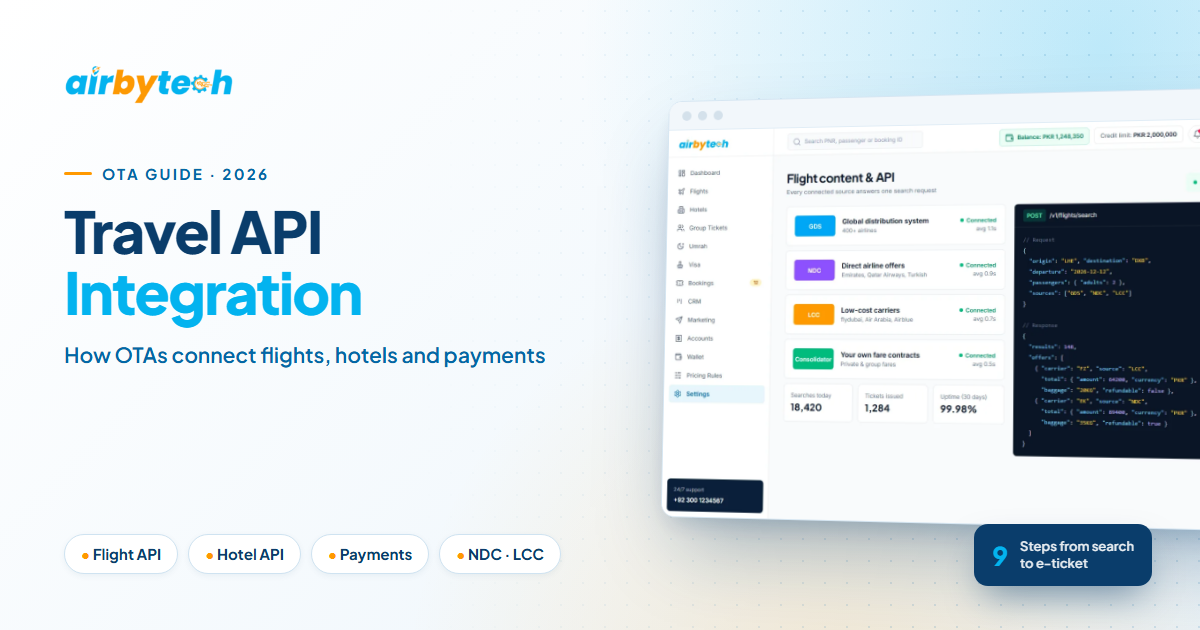
| Flight API | Availability, fares, booking and ticketing | GDS (Amadeus, Sabre, Travelport), airline NDC, low-cost carriers |
| Hotel API | Rooms, rates, photos and confirmations | Hotel banks, wholesalers, chains |
| Payment API | Card and wallet payments, refunds | Payment gateways, local wallets, bank transfer |
| Transfer & tour API | Airport transfers, activities, sightseeing | Ground-service and activity suppliers |
| Insurance & visa API | Travel insurance policies, visa applications | Insurers and visa service providers |
| Utility APIs | Currency rates, SMS, email, maps | Exchange-rate, messaging and map services |
New to the GDS side? Start with our guide on what a GDS is in travel.
How a booking flows through the APIs
Here is what happens when a traveller books a return flight on your site:
- Search. Your platform sends the same search to every connected flight API at once.
- Normalise. Each supplier answers in its own format. Your system converts them into one standard format and removes duplicates.
- Price. Your markup rules are added: by airline, route, channel or agent group.
- Show results. The traveller sees one clean list sorted by price, time or stops.
- Revalidate. When a flight is chosen, the price is checked again with the supplier because fares change quickly.
- Book. Passenger details go to the supplier, which returns a PNR.
- Pay. The payment API charges the card or wallet. If payment fails, the booking is released.
- Ticket and confirm. The ticket is issued and the e-ticket and invoice are emailed automatically.
- Account. Sales, supplier payable and profit are posted to your back office.
All of this should take seconds. If any step is slow or fails silently, you lose the sale.
Benefits of travel API integration
- Real-time inventory: no outdated prices or "sorry, that seat is gone" calls.
- More content, better prices: compare several suppliers in one search.
- Automation: fewer manual tickets, fewer mistakes and a smaller back-office team.
- Scalability: serve 10 or 10,000 searches a day with the same staff.
- New channels: the same APIs power your B2C website, your B2B agent portal and your mobile apps.
What integration really involves
Connecting an API is more than "plugging it in". A proper integration covers:
- Supplier contract and credentials: test (sandbox) and live access.
- Development: search, book, cancel, refund and reissue flows.
- Certification: many GDS and airline APIs must test and approve your integration before going live.
- Error handling: timeouts, price changes and partial failures must be handled cleanly.
- Caching: to keep searches fast without breaking supplier rules.
- Monitoring: alerts when a supplier is slow or down.
- Maintenance: suppliers update their APIs regularly; your platform has to keep up.
Tip: Ask any technology partner which APIs are already live in production and which are only "possible". Live integrations save months.
Common mistakes OTAs make
- Starting with too many suppliers. Launch with one strong flight source and one hotel source, then add more.
- No price revalidation. Customers pay one price and the supplier charges another.
- Ignoring after-sales APIs. Refunds and changes done by hand eat your team's time.
- One flat markup. You lose on competitive routes and leave money on easy ones.
- Weak payment flow. Unclear failure handling leads to paid bookings without tickets, or tickets without payment.
How much does travel API integration cost?
Cost depends on three things:
- Supplier fees: some APIs charge per search, per booking or a monthly fee.
- Development: building and certifying each integration from scratch is the biggest cost.
- Maintenance: ongoing updates and monitoring.
Using a platform where the main APIs are already integrated, such as our flight API integration and hotel API integration, cuts development cost and launch time sharply. See our pricing for typical packages.
A simple plan to launch your OTA
- Decide your market and products: flights only, or flights, hotels and Umrah?
- Choose your channels: B2C website, B2B portal or both.
- Pick your first suppliers and sign contracts.
- Choose your technology partner with those APIs already live.
- Set up payments: gateway, local wallets and agent wallet with the payment and wallet module.
- Set pricing rules and test real bookings in sandbox.
- Go live, measure and add suppliers as you grow.
Connect your travel business with Airbytech
Airbytech delivers booking engines with flight, hotel and payment APIs already working, so you can focus on selling instead of coding.
- See it working: try our live demos
- Plan your integration: talk to our team
Frequently asked questions
Q1: What is travel API integration?
Travel API integration means connecting your website or booking portal to suppliers such as airlines, GDS, hotel banks and payment gateways through APIs, so availability, prices and bookings are handled automatically in real time.
Q2: Which APIs does an online travel agency need?
Most OTAs need a flight API (GDS, NDC or low-cost carriers), a hotel API, a payment gateway, and often transfer, tour, insurance and visa APIs. The mix depends on what you sell.
Q3: How long does a travel API integration take?
A single new API can take a few weeks, including supplier certification. Using a platform with APIs already integrated lets you launch much faster.
Q4: Do I need my own supplier contracts?
Usually yes for GDS and some airlines, as you sell under your own agreements. Some suppliers can also be accessed through your technology partner or a consolidator.
Q5: What is the difference between GDS and NDC APIs?
A GDS API gives access to published fares from many airlines through one provider. An NDC API connects to an airline's own offers, including bundles, seats and bags. Modern OTAs often use both.
- #Travel API
- #Flight API
- #Hotel API
- #OTA Development
- #NDC
- #Payment Gateway Focus
Written by
Airbytech Owner
The Airbytech team builds B2B and B2C booking platforms, GDS integrations and agency software for travel businesses worldwide.
See it working
Try the Airbytech portals with demo logins
Explore the live B2B agent portal and B2C booking website, then talk to us about launching one under your own brand.