travel CRM A customer sends a WhatsApp message asking for Dubai packages. Your agent replies, promises to send options, and then gets busy with walk-in customers. Three days later the customer has booked somewhere else. Not because your price was higher, but because nobody followed up.
This is the most common way travel agencies lose business. A travel CRM fixes it. This guide shows how.
What is a travel CRM?
A travel CRM keeps every enquiry, conversation and follow-up in one place. Instead of leads living in different staff phones and notebooks, your whole team sees:
- who enquired, when, and from where,
- what was discussed on every call or chat,
- what was quoted,
- when the next follow-up is due, and who owns it.
Why agencies lose enquiries
| Problem | What it costs you |
|---|---|
| Slow first reply | The customer asks three agencies and books with the fastest |
| Forgotten follow-ups | Interested customers go cold |
| Leads on personal phones | When a staff member leaves, their customers leave too |
| No record of what was quoted | Confusing, inconsistent offers |
| No idea which marketing works | Budget wasted on ads that bring no bookings |
The 5 things a good travel CRM does
1. Captures every enquiry automatically
Website forms, WhatsApp, phone calls, walk-ins and partner referrals should all land in one list. Website enquiries should become leads without anyone typing them in.
2. Organises leads into a clear pipeline
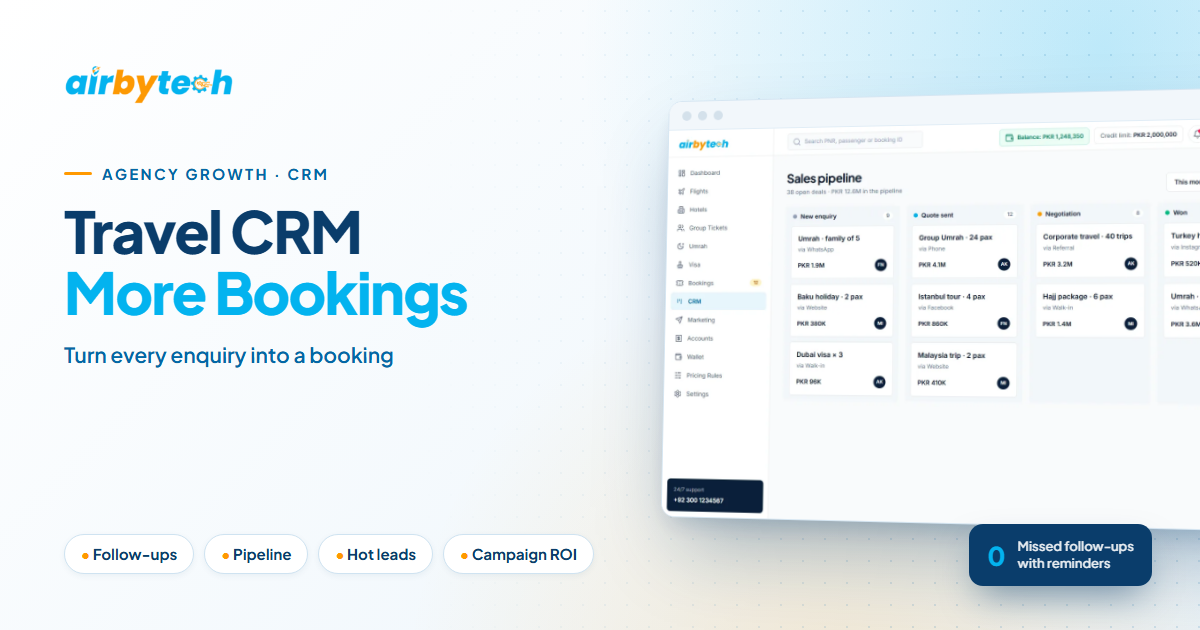
Every lead moves through simple stages, such as New, Contacted, Interested, Quotation sent, Negotiation, Won or Lost, so you can see at a glance where every deal stands.
3. Shows which leads are hot
Mark leads as hot, warm or cold. Your best salespeople should spend their morning on hot leads, not on old enquiries that will never book.
4. Never misses a follow-up
After every call, the agent sets the next follow-up. The CRM reminds them by email when it is due and shows overdue leads in red, so managers can step in.
5. Measures your marketing
When each lead is tied to its source and campaign, you can see how many leads and bookings each Facebook ad, Google campaign or exhibition brought, and what each lead cost.
Follow-up rules that win more bookings
- Reply within minutes, not hours, especially to website and WhatsApp enquiries.
- Always set a next step before ending a call: a date, a time and what you will send.
- Use ready-made messages for common replies such as quotations, reminders and thank-yous, so every customer gets a fast, professional answer.
- Log every conversation. If a colleague picks up the lead tomorrow, they know exactly what was promised.
- Close the loop. Mark lost leads with a reason ("price", "dates", "chose another agency"). Those reasons tell you what to fix.
Numbers every agency owner should watch
| Metric | What it tells you |
|---|---|
| Response time | How fast your team answers new enquiries |
| Conversion rate | What share of all leads become bookings |
| Win rate | Of the leads that closed, how many you won |
| Overdue follow-ups | Bookings at risk right now |
| Cost per lead | What each campaign pays for one enquiry |
| Return on marketing spend | Which campaigns actually make money |
CRM for your whole team, including partners
A good CRM lets you assign leads to staff members, and even to trusted partners, while you keep full visibility. Each person sees only their own leads and follow-ups, and the owner sees the whole picture on one dashboard.
If you work with a referral network, read how a B2B travel portal and partner program fit together.
Getting started
- List where your enquiries come from today: WhatsApp, website, phone, walk-ins, partners.
- Agree on your pipeline stages and what "hot", "warm" and "cold" mean for your agency.
- Import your existing contacts from Excel so nothing is lost.
- Set one rule: no lead without a next follow-up.
- Review the dashboard weekly: overdue follow-ups, win rate and the best campaigns.
Try Airbytech's travel CRM
Airbytech's Travel CRM, Lead Management and Marketing CRM bring enquiries, follow-ups, campaigns and reports into one place, built for travel agencies.
- See it working: try our live demos
- Talk to us: book a free consultation
Frequently asked questions
What is a travel CRM?
A travel CRM (customer relationship management system) keeps every enquiry, customer, conversation and follow-up in one place, so a travel agency can respond quickly, follow up on time and turn more enquiries into bookings.
Why do travel agencies lose leads?
Mostly because of slow replies and missed follow-ups. Enquiries arrive on WhatsApp, phone and the website, get scattered across staff phones, and nobody calls back at the right time.
What should a travel CRM track?
The source of each lead, its stage (new, contacted, quotation sent, won or lost), how hot it is, every call and message, the next follow-up date, and who on the team owns it.
Can a CRM show which marketing works?
Yes. When every lead is tied to its source and campaign, the CRM shows leads, bookings, cost per lead and return on spend for each campaign.
Is a CRM useful for a small agency?
Yes. Even a team of two or three loses bookings when follow-ups are forgotten. A simple CRM with reminders often pays for itself with the first few saved bookings.
- #Travel CRM
- #Lead Management
- #Travel Agency Marketing
- #Sales Pipeline
- #Follow-ups
Written by
Airbytech Owner
The Airbytech team builds B2B and B2C booking platforms, GDS integrations and agency software for travel businesses worldwide.
See it working
Try the Airbytech portals with demo logins
Explore the live B2B agent portal and B2C booking website, then talk to us about launching one under your own brand.