Search a route on an airline's own website and you often see something your agency screen does not: fare bundles with bags and seats, special promotions, and a clear choice between "Light", "Value" and "Flex". For years, travel agents could not sell those offers properly. NDC is how airlines are changing that.
This guide explains what NDC is in plain words, how it differs from the GDS, why airlines are pushing it, and how your agency can sell NDC fares without making life harder for your team.
What is NDC in travel?
NDC (New Distribution Capability) is a data standard created by IATA, the global airline association. It lets an airline build its own offer, with the price, the fare family, baggage, seats, meals and extras, and send it directly to a travel agency or booking platform.
In short: with NDC, the airline builds the offer; with the classic GDS, the offer is put together from fares the airline filed earlier.
IATA's own overview is on its NDC program page.
Why airlines want NDC
- Better retailing: airlines can sell the same rich offers they show on their own websites, including bundles and paid extras.
- Personalised prices: offers can change by market, channel or customer type.
- Lower distribution costs: some airlines add extra fees to bookings made through older channels, and keep their best content for NDC.
- Faster changes: new products reach agencies without waiting for older systems to catch up.
NDC vs GDS: the key differences
| Classic GDS | NDC | |
|---|---|---|
| Who builds the offer | Built from fares the airline filed in advance | Built by the airline at the moment you search |
| Content | Published fares and booking classes | Fare families, bundles, seats, bags, meals and special fares |
| Technology | Older EDIFACT messages | Modern XML APIs |
| Ancillaries | Limited and often manual | Sold in the same booking |
| Airline fees | Some airlines charge extra fees | Usually the airline's preferred channel |
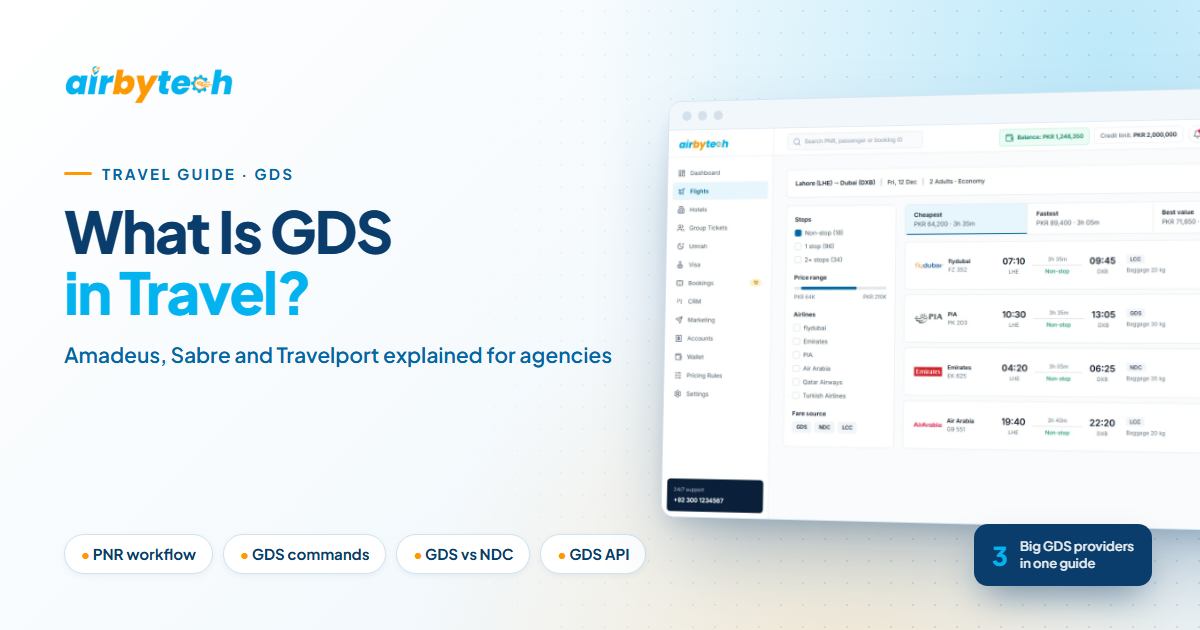
The GDS is not going away. GDS providers now also distribute NDC content, so most modern agencies use both. If the GDS side is new to you, read our guide on what a GDS is in travel.
What NDC means for your agency
More choice for customers
Your agents can show the same fare families travellers see on airline websites, so customers can compare "with bag" and "without bag" fares on one screen.
More to sell on every booking
Seats, extra baggage and meals can be added during the booking, not by calling the airline afterwards. That means a better service and extra margin.
Access to special fares
Some airlines publish promotions or route-specific fares only through NDC. Without NDC content, your agency may simply not see them.
Changes in after-sales
Changes, cancellations and refunds work differently from classic ticket reissues. Your system should handle these steps so your team does not have to learn each airline's rules.
The challenges, honestly
- Every airline is different. Each NDC connection has its own content and rules.
- Servicing is still maturing. Some changes and refunds are easier than others, depending on the airline.
- Comparing sources is harder. The same flight can appear from GDS and NDC at different prices.
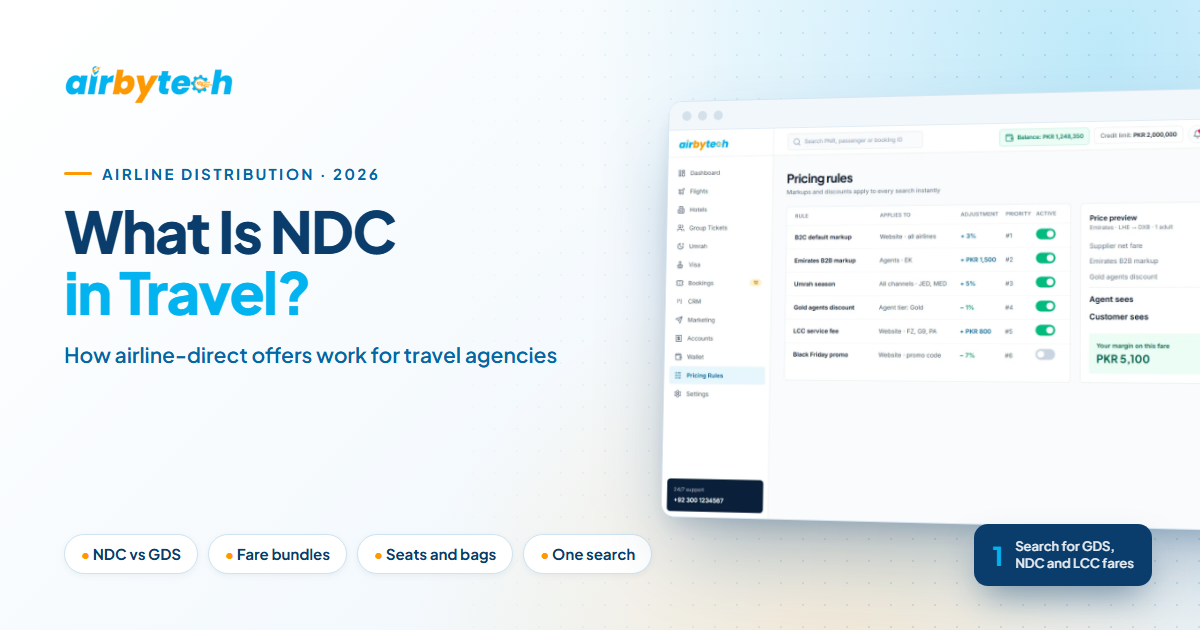
The answer is not to choose one source, but to use a platform that merges GDS, NDC and low-cost carriers into one clean search, removes duplicates, and shows your agents the best option.
How to start selling NDC fares
- Pick the airlines that matter to you. Start with the carriers your customers fly most, such as Gulf carriers for Pakistan and Middle East routes.
- Choose how to connect: directly to an airline, through an NDC aggregator, or through a GDS that supports NDC.
- Use one booking screen. Agents should not need a separate tool for NDC. See how our flight booking engine shows every source in one search.
- Set your markups once. Apply the same pricing rules to NDC and GDS fares.
- Train on after-sales. Make sure your team knows how changes and refunds work for NDC bookings.
For the technical side of connecting suppliers, read our travel API integration guide.
NDC and your sub-agents
If you run a network of sub-agents, NDC content becomes even more valuable: every agent in your B2B travel portal can book richer fares and extras without any extra setup on their side, and you control the markup centrally.
Sell GDS and NDC fares from one portal
Airbytech's flight API integration brings GDS, NDC and low-cost carriers into one search for your website, your B2B portal and your team.
- See it working: try our live demos
- Plan your setup: talk to our team
Frequently asked questions
What does NDC stand for?
NDC stands for New Distribution Capability. It is a data standard created by IATA that lets airlines send their own offers, including bundles, seats and bags, directly to travel agencies and booking platforms.
Is NDC replacing the GDS?
Not completely. GDS providers now also carry NDC content, and many agencies use both. NDC changes how airline offers are built and sent, while the GDS remains a major channel for searching and ticketing.
Are NDC fares cheaper?
Often they can be. Some airlines publish special fares, bundles or promotions only through NDC, and some charge extra fees on bookings made through older channels. It varies by airline and route.
Do I need a new system to sell NDC fares?
You need a booking platform connected to NDC content, either directly to airlines, through an aggregator or through a GDS that supports NDC. Your agents can then book NDC fares from the same search screen.
Can NDC bookings be changed or refunded?
Yes. NDC supports changes, cancellations and refunds, but the steps differ from classic GDS ticketing. A good portal handles these after-sales actions for you.
- #NDC
- #IATA
- #GDS
- #Airline Distribution
- #Flight Booking API
- #Travel Agency
Written by
Airbytech Owner
The Airbytech team builds B2B and B2C booking platforms, GDS integrations and agency software for travel businesses worldwide.
See it working
Try the Airbytech portals with demo logins
Explore the live B2B agent portal and B2C booking website, then talk to us about launching one under your own brand.