Umrah package pricing Every Umrah agency knows the feeling: a customer asks for "a 15-day package, 5-star in Makkah, 3 adults", and your team spends the next hour on calculators, hotel rate sheets and WhatsApp messages to suppliers. Price it too high and the customer goes elsewhere. Price it too low and the profit disappears.
This guide walks through Umrah package pricing step by step: every cost to include, how to price per person, how to handle seasons and exchange rates, and how to quote much faster.
The building blocks of an Umrah package pricing
| Cost | How it is usually priced | Notes |
|---|---|---|
| Umrah visa | Per person | Processed through approved Saudi channels and agents |
| Flights | Per person, return | Group seats are often cheaper than individual fares |
| Makkah hotel | Per room, per night | Distance from the Haram drives the price |
| Madinah hotel | Per room, per night | Usually fewer nights than Makkah |
| Transport | Per vehicle or per seat | Airport transfers and the Makkah–Madinah journey |
| Ziyarat | Per group or per person | Optional guided visits in Makkah and Madinah |
| Meals | Per person, per day | Optional; many packages are room-only |
| Insurance and extras | Per person | Travel insurance, SIM cards, guides |
| Your margin | Per person or per package | Fixed amount or a percentage |
Step 1: Price the hotels by room, then by person
Hotels are the biggest and most variable cost. They are priced per room per night, but customers pay per person. So:
- Multiply the room rate by the number of nights.
- Divide by the number of people sharing the room.
Example: a Makkah quad room at SAR 600 per night for 10 nights = SAR 6,000. Shared by 4 people = SAR 1,500 per person. The same room as a double costs SAR 3,000 per person.
That is why every Umrah quote should show prices for double, triple, quad and sharing rooms side by side.
Step 2: Add the per-person costs
Add the visa, return flight, insurance and any per-person transport seats. If you use group seats, use your actual cost per seat, not the public fare.
Step 3: Add transport and ziyarat
Transport is often priced per vehicle. Divide the vehicle cost by the group size, and remember that a family of 4 in a private car costs more per person than 40 pilgrims in a coach.
Step 4: Convert currencies carefully
Most Saudi costs are in riyals (SAR), while your customers pay in rupees or another currency. To protect your margin:
- Keep supplier costs in SAR and convert at one rate you review regularly.
- Add a small buffer to the exchange rate for quotes that stay open for several days.
- Set an expiry date on every quote.
Step 5: Add your margin the smart way
- Economy packages: customers compare on price, so a smaller fixed margin per person works well.
- Premium packages: customers value service, hotel location and convenience, so a percentage margin is fair.
- Add-ons such as ziyarat, meals and private transport are good places for extra margin.
Step 6: Plan for the season
Prices change sharply through the year. Ramadan, school holidays and the weeks around Islamic events push hotel and flight prices up, while quieter months are cheaper. Keep separate rate sheets per season, and update group seat prices as availability changes.
Common pricing mistakes
- Pricing per room instead of per person and confusing customers.
- Forgetting transport and transfers until after the quote is accepted.
- Using an old exchange rate while the riyal has moved.
- No expiry date on quotes, so customers come back weeks later expecting the old price.
- Recalculating everything by hand for each enquiry, which is slow and error-prone.
Quote in minutes, not hours
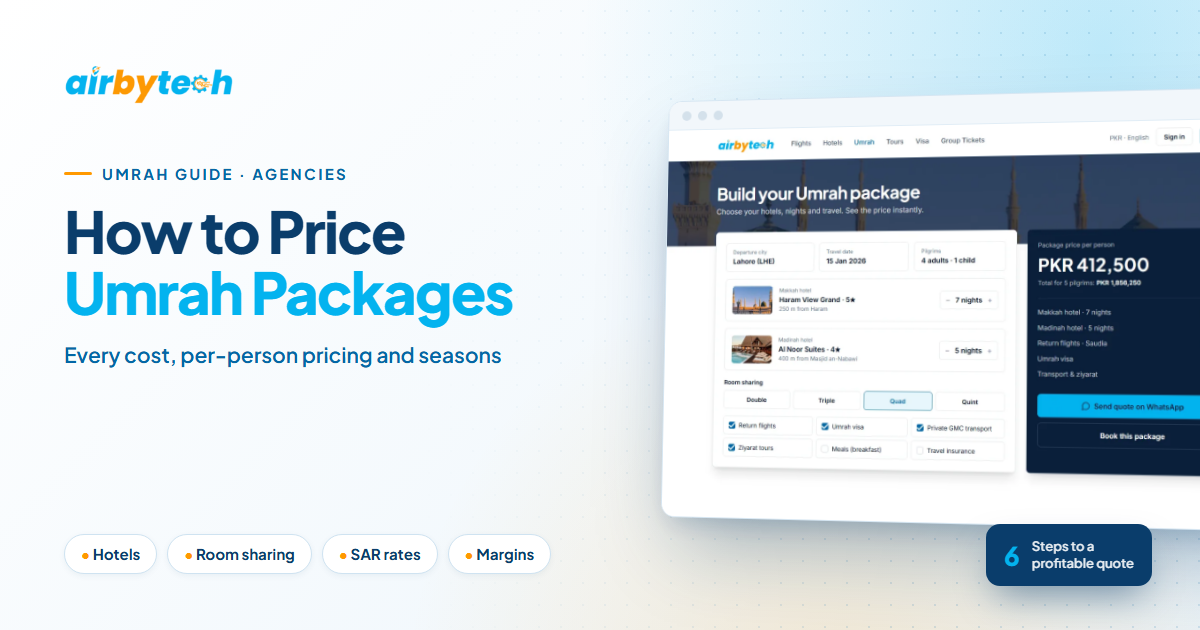
An Umrah package calculator stores your hotel rates, room types, transport costs, visa fees and markups once. Your team picks the hotels, dates and number of pilgrims, and the calculator builds a clear per-person quote for every room type, ready to send on WhatsApp.
See how our Umrah package calculator does this, and how the Umrah CRM then manages pilgrims, documents, rooming lists and payments once the customer says yes.
Sell Umrah packages online
Once your pricing is organised, you can sell packages online through your own B2C booking website, and sell group seats and packages to sub-agents through a B2B travel portal.
- See it working: try our live demos
- Talk to us: book a free consultation
Frequently asked questions
What costs make up an Umrah package?
The main costs are the visa, return flights, hotels in Makkah and Madinah, ground transport and transfers, ziyarat tours, and optional meals and insurance, plus your service fee or markup.
How do agencies price Umrah packages per person?
Hotel rooms are priced per room, so divide the room cost by the number of people sharing it (double, triple, quad or sharing). Add the per-person costs such as visa and flight, then your margin.
Why do Umrah prices change so much during the year?
Demand changes by season. Ramadan, school holidays and the weeks around Islamic events raise hotel and flight prices, while quieter months are cheaper.
How should I handle the riyal exchange rate?
Price Saudi costs in SAR, convert them at a rate you review regularly, and keep a small buffer so currency movements do not wipe out your margin.
How can I quote Umrah packages faster?
Use an Umrah package calculator that stores your hotel rates, transport costs and markups, so your team can build an accurate quote in minutes instead of working it out by hand.
- #Umrah Packages
- #Umrah Pricing
- #Umrah Agency
- #Makkah Hotels
- #Umrah CRM
- #Travel Agency
Written by
Airbytech Owner
The Airbytech team builds B2B and B2C booking platforms, GDS integrations and agency software for travel businesses worldwide.
See it working
Try the Airbytech portals with demo logins
Explore the live B2B agent portal and B2C booking website, then talk to us about launching one under your own brand.